
Written by Domenic M. Mallozzi, N1DM
Providence Radio Association, Inc.
1 Ludlow Street, Johnston, R.I.
December 2016
Web edition prepared from the club’s December 2016 history. The original wording, spelling, names, call signs, dates, and source notes have been preserved; only document layout and line breaks have been adapted for the web.
Contents
- Introduction
- Editor’s Preface
- Dedication
- In the Beginning (through the 1920s)
- The 1930s
- The 1940s
- The 1950s
- The 1960s
- The 1970s
- The 1980s
- The 1990s
- The New Millennium
- Radio Stations of the PRA
- Field Days
- Other Activities
- Appendix 1 – List of Abbreviations Used
- Appendix 2 – Other References
- Appendix 3 – PRA Membership Roster as of 2016
- Appendix 4 – PRA Officers Database
- Appendix 5 – PRA Contest List
- Appendix 6 – Publications by PRA Members
- Credits
Introduction
For any local organization to exist for more than a generation is unusual, this makes the Providence Radio Association (PRA) a rarity. For over 95 years it has existed in the vicinity of Providence, Rhode Island to serve the amateur radio community and the community at large. The changes over the years are eye popping, the PRA started when CW was supplanting spark and the club continues today where digital communications is vying to supplant traditional analog voice modes like AM, FM and SSB. When the PRA was first organized electronic computers were a theoretical concept and ham call signs had no letter prefixes. It started meeting in member’s homes and today has its own club building1. The members have always shown an interest in promoting technology as it progressed from the latest homebrew receiver of the 20’s2 to RTTY to a 220 FM repeater in 1979 and to an ATV repeater in 1984. To this day a PRA meeting is a collection of people discussing the newest electronics technology. Just looking at the publications credits and contest results for members shown in the appendices will show interest in RF from VLF through microwave and technical topics such as SSB rigs, antennas, propagation, satellites, ATV, contesting and other subjects. A reflection of the varied interests of its membership is shown by the fact that the W1OP call sign has been heard all over the bands from 1.8 through 1296 MHz, on OSCAR satellites, and in CW, AM, FM, SSB and ATV modes among others.
Despite the changes in the hobby over the years the PRA has been place for members to share our common hobby among the rich and poor, young and old. The more than 300 members over the years can attest to the fact that it was a place to learn. The PRA has always remembered that it existed to promote amateur radio in all its various forms. Education of the members, public service, technical interests, camaraderie and operating activities have coexisted with little friction. The camaraderie of the membership is something to be appreciated, with the club’s once a member always a member “rule”. As you read the history you will notice from the 20’s to today there is often mention of social events, which allowed our families to share the camaraderie with us. For some members ham radio was a family affair with husbands and wifes both licensed or many members of a family over two generations involved like the Bromberg, Depetrillo, Muto and Titterington families with multiple members.
The PRA also remembered its responsibility to the community with members who over the years supported Civil Defense, the WWII home front efforts and Red Cross operations among many others. For many years the ARRL Section Emergency Coordinator (now EC) was a PRA member.
Since 1921 our members supported the American Radio Relay League (ARRL). Looking at the record we had many years of being a 100% club, and also often having a club member as the section manager. In fact it is hard to find a section level ARRL appointment that has not been held by a PRA member at one time or another. While there have been some disagreements with certain ARRL positions over the years they did realize that the ARRL does represent the amateur’s positions as a whole.
Many hams whose interest in ham radio was nurtured by the PRA have moved out of state for career or retirement, but they still fondly remember the PRA. For those members the W1OP call sign still brings to mind the good memories of a station where “the amateur radio operator is KING”3. It is still not unusual for operators at W1OP to get a friendly “hi” from a station who was a past member. A look at the logs and QSL collection of W1OP shows both the common and the exotic QSO’s clearly showing that the PRA station is really active, not just a paper creation for Field Day as many club calls are.
It is also important to note we have many members who have been members and were active for over 25 years. Their activity has brought both continuity and a memory of the clubs mission and history that has allowed the club to stay focused. Our members are active in all facets of the hobby, attending a hamfest or fleamarket in southern New England almost guarantees that you will run into one or more PRA members. Tuesday night meetings also still bring out the gang for the normal camaraderie as well as comparing the newest toy or listening up and down the bands from W1OP for that new one to enter into the log.
The history that follows is far from complete, it is based on personal reminiscences and various published accounts unfortunately records for many years do not exist so we can only give glimpses into those periods. Despite these shortcomings, this history will hopefully convey the flavor of a unique organization that continues to thrive in the 21st century.
Notes & references from the original document
- 1956 New England Convention Booklet: Discussion of the PRA history by Richard A. Cordin-W1NZR: PRA: October 21,1956
- Providence Journal: June 3, 1923: pg. S5-11
- PRA New England Division Convention Booklet for September 28, 1958:PRA: Comments about the PRA by Richard A. Cordin, W1NZR
Editor’s Preface
Over the last 40 years we have discussed producing a formal history of the PRA more than a few times. Despite many anniversaries and other events of the club where it seemed appropriate to compile a complete history, for various reasons, the project never came to fruition. In the last ten years some chance conversations and e-mails between John Good-W1GS, Dom Mallozzi-N1DM, Dave Tessitore-K1DT and Mark Titterington-W1EOF have resulted in a real effort to get the history project on track.
Over the last ten years the task of researching this history has been a pleasure because of the cooperation from various club members, and the staffs of the public libraries in Providence, Boston, and Worcester. Access to the libraries at Worcester Polytechnic Institute, the University of Vermont, the University of Connecticut and Tufts University were also a great help. The Rhode Island Historical Society library was a source of city directories prior to 1950 as well as old issues of the Providence Journal. But by far the most useful source of information has been QST magazine published by the American Radio Relay League (ARRL) and the file of club records and correspondence in the ARRL Club and Training Department. The ARRL staff has been most helpful in providing copies of old annual reports by the PRA to the ARRL along with access to their call book collection.
The only sad part of the task has been the fact that many original members who would have been happy to see this history have become silent keys in the interim. Many of us knew some of the club’s founders but failed to document their memories of events and persons that would have made this history more complete. Despite this shortcoming we are lucky to have the many documents that the club has preserved in its archives along with the many mentions in the Section News and Station Activities columns of QST and the articles in the local newspapers to provide a clearer picture of the PRA and its activities.
I have attempted not only to produce an easy to read narrative but have taken a somewhat academic approach to footnoting. To some the ”school term paper” approach may seem a bit unusual, but the purpose is to provide future historians of the PRA a clearly documented starting point for future editions of this history. (Anyone finding an error or omission is asked to contact me so we may update future editions.) Also, I can imagine many hams will be surprised to see calls without a letter prefix (W, K, A or N) like 1BES, this is done to be historically correct, as prior to 1928 hams did not have a letter prefix to their assigned call signs. Also, because many of us have held multiple calls over the years you may see many people referred to by more than one call in the text depending on when a particular incident occurred. Referring to the roster of members in the appendices will clarify the multiple calls held by an individual. You will also occasionally see a call in parenthesis, this is done to clarify when a source did not show the individuals call (such as a newspaper article) but were able to ascertain it from other sources. This is a history written by hams, about hams and for hams, which means that we have not tried to clarify terminology that is the lexicon of the hobby but would seem to be gibberish to the uninitiated. I refer the non-ham readers to the List of Abbreviations at the end of this manuscript to clarify these terms.
I realize that some information is presented in more than one section, this was done to make those sections stand alone and avoid the need to have a reader switch from section to section to get a complete story of an activity. The ‘Field Days’ and ‘Other Activities’ section is a way to gather in one place a group of stories that cover the multiple decades of participation in certain activities in one place for a more coherent presentation than could have been produced in the chronological format of the remainder of this history.
Also, for the first time we have attempted to start collecting club scores and publications by members as lists. This was done specifically to show the continual activity of the club and its members and the varied interests that have been represented at one time or another on the hill.
As editor, I will take the liberty of a personal comment to say that I have produced this history in a small way to show appreciation to the club for giving me a place to start and encouraging my ham radio career. My association with ham radio has brought many lasting friendships and great pleasure. Despite a membership lapse of over 25 years I still felt welcome when I showed up on the hill, as the club still welcomes former members with the ‘once a member always a member’ attitude. The exposure to the different technical interests at the club peaked my technical curiosity and encouraged not only my interests in the various parts of the hobby but encouraged my engineering career path. I have also benefited from the knowledge of the many talented members who remember that one of the clubs missions is to promote the technical education of the membership. To this day I continue to use some of the things I learned at the PRA in my professional engineering employment. It is therefore with great personnel pleasure that I present this history to the club.
Domenic M. Mallozzi, N1DM (ex-WN1RFT, WA1RFT) Natick, MA December 2016
Dedication
To the eight charter members of the Providence Radio Association:
- Earl Baldwin
- Lewis S. Bellem
- Harold O. Brewster
- Joseph W. Cohen
- Allen Cordin
- Howard O. Cushing
- L. Clifford Leighton
- Stanley S. Read
Who started a lasting organization over nine decades ago that continues to contribute to the advancement of the radio art and the fraternity of our shared hobby.
In the Beginning (Thru the 1920’s)
The Providence Radio Association (PRA) started in 1919 in the Elmwood section of Providence, RI. As far as can be determined at this time the members were young men with a common interest in the wonders of wireless. Amateurs had been off the air since the beginning of World War I and in that period all amateur licenses had expired and that it was not until November 1919 that hams got back on the air4. The club was formed by amateurs who were itching to get back on the air and those who had to wait for the war to end to allow them their chance at transmitting. When many amateurs had left for war spark was still king, during the war many were exposed to CW (spark was legal on US ham bands until 1927). Even though the PRA was not the first ham radio club in RI, it was an early club (the earliest RI club that we find a reference to is the “Rhode Island Wireless Association” in 19105) and is the earliest surviving RI ham club. By September 1920 the group became more organized and were referred to as the Elmwood Radio Association. The eight original members were Lewis S. Bellem, Stanley S. Read, Howard O. Cushing, Harold O. Brewster, Earl Baldwin, L. Clifford Leighton, Joseph W. Cohen and Allen Cordin.6 As the Elmwood Radio Association they met at Lew Bellem’s home at 99 Stanwood Street weekly to discuss radio and help each other. By 1921 they needed larger quarters and moved to the Providence YMCA on Broad Street and decided to change the name to the Providence Radio Association to reflect that they wanted to be more than a neighborhood organization.
After a year the club filed a “Resolution of Affiliation” with the American Radio Relay League (ARRL) in October 19217, with Lew Bellem, 1BES as president and Lew Leighton, 1ETD as secretary signing for the club. At that time the club was meeting in rm. 201 of the YMCA on Broad Street in Providence (a location the club would use on and off through the mid 1940’s). This resolution was approved by the ARRL on November 19, 1921 and an ARRL club charter of affiliation was issued. The members were a small group that continued to grow as the wireless boom of the 20’s occurred. By 1922 the clubs expansion caused a move to a rented facility at 159 Niagara Street.6 From 70 members in 19228 the club had grown by 1923 to 101 members9 (of whom 31 were licensed). The fact that three years later in 1926 there were only 43 ham stations10 (not counting 1LI) licensed in Providence shows that the club was the major organization for hams in the city of Providence. In fact the period for licenses was 2 years in this era and in 1926 there were only 14,902 amateur licenses11 in the US and its possessions.
The club realized from the beginning that the regulatory issues of our hobby were important. As one of the few hobbies that had codified federal regulations along with various local regulations and codes affecting it, this was a critical area that could not be ignored. They also recognized from the beginning that this meant representing the interests of all amateurs not only its members. This is shown in an early article in the Providence Journal5 about the clubs reaction to new radio regulations. The club has continued this representation of its members and the hobby in general in rule making issues to this day.
The club members were active in the experimentation that marked the continuing development of radio at that time. In fact Alpha Learned, 1AAU one of the PRA’s early presidents (and a ham and commercial operator prior to World War I) published three technical items in QST in the 20’s12 13 14. As most hams of the day did, the clubs membership was active in building their own equipment as is shown by a 1923 article in the Providence Journal that reported that the PRA had sponsored a receiving set contest15 for its 100 members. This contest was judged by John E. Marshall, Lou Bellem (1BES), and Harry H. Tilley (1GV). The winners were for two or more tubes Alpha Learned (1AAU), in the two-tube class Horrace Young (1CAB), in the one tube class Chester Ward (1ARK) and second in the one tube class was Clarence Miller. The article shows a picture of the proud winners with their professional looking gear and comments on Alpha Learned’s professional looking work which was consistent with his holding a commercial ticket and experience as a shipboard operator knowing the importance of good construction. This tradition of home brewing continues to this day as shown in the amplifiers in use at the W1OP shack in 2004 as well as the continued home brewing activity of various members.
The PRA became one of the few club licensees in the early part of the century when in 1925 the club obtained 1LI16. This made it one of only three club stations in Rhode Island that year (the other two being at Pawtucket High School and at St. George’s School in Newport). In fact in 1925 only 8 non-school radio clubs existed in New England and in 2004 the PRA and the American Radio Relay League (ARRL) station are the only two of that group still active. Little is known of this station other than the details contained in the various U.S. government call books at the time and the annual reports made by the club to the ARRL. In 1925 the club showed a power of 50 watts, which sounds pretty run of the mill today. But it was a good sized station when we consider that in 1925 the highest power commercial broadcast station in Rhode Island was 500 watts and one station was a part timer running 20 watts17. In 1928 when the international radio convention required the use of prefixes indicating the country of the station, the PRA was among the original group of ham stations that sported the new W prefix to their calls.
Notes & references from the original document
- DeSoto, Clinton B.: Two Hundred Meters and Down: West Hartford, CT: ARRL: 1935: page 59
- DeSoto, Clinton B.: Two Hundred Meters and Down: West Hartford, CT: ARRL: 1935: page 30
- “Wireless Fans Cooperate”: Providence Journal: December 3, 1922,section 5, page 2
- On file with the American Radio Relay League, Inc. (ARRL): 225 Main Street: Newington, CT 06111
- “City Radio Association Protests New Regulations”: Providence Journal: January 27, 1922: page 9
- Annual Report to the ARRL dated 5/10/1923 on file with the ARRL in Newington, CT
- “Amateur Radio Stations of the United States”: Edition June 30, 1926: Department of Commerce, Bureau of Navigation, Radio Service: page 29
- DeSoto, Clinton B.: Two Hundred Meters and Down: West Hartford, CT: ARRL: 1935: page 114 & 132 (quote from Department of Commerce annual report for 1926)
- “Learned, Alpha A. (1AAU): “A Calibrated External Hetrodyne and Wave Meter”: QST: October 1922: page 37 [ NOTE: QST magazine referred to in these footnotes is published by the American Radio Relay League, Inc.: Newington, CT ]
- Learned, Alpha (1AAU): “A Compact Receiver”: QST: February 1927: page 34
- Learned, Alpha: “Frequency vs. Wavelength” (“Experimenter’s Section”: QST: July 1929: page 45
- Providence Journal: June 3, 1923: pg. S5-11
- “Amateur Radio Stations of the United States”: Edition June 30, 1925: Department of Commerce, Bureau of Navigation, Radio Service: page 20
- Providence Journal Almanac 1926: Providence Journal Co.: Providence, RI: page 56
The 1930’s
PRA members have always been interested in leading edge technology; and in the thirties they were very interested in 56 Mc/s18 operation. At that time 56 Mc/s was the new frontier.
On April 7th, 1933 the PRA incorporated in the State of Rhode Island solidifying its legal status.
In January 1934 the PRA held a ham fest that was attended by among others director Bailey of the New England Division of the ARRL. This was not the last time that the club sponsored a hamfest and this event was just a hint of things to come.
The PRA found a new home in 1934 when they moved to a new QTH at 3 Valley Street which had previously been a broadcast station with two 80 foot towers. The 80 foot towers were obviously an inducement19. In 1934 the club again decided it needed a club call and W1INM was issued. Until 1955 this call was the clubs rallying point. The RI Section News column in QST for March 1935 indicated the club had a new transmitter to go with their new call. It is apparent that in the 30’s the club maintained a station on 80 meters with 200 watts input. Obviously this got active use as is demonstrated by the 1935 QSL card for a 80M CW QSO with W8JKR in June of 1935 shown later in this history. Despite numerous moves over the next 20 years the records show that the club continued to be serious about maintaining a club station.
The PRA’s annual hamfest was held at the club’s new location on January 19, 1935 offering contests, technical discussions and dinner20. The new location allowed the club to offer continued education of its members in the radio arts. Among these educational activities were radio theory talks by Dr. Andrews at the PRA classrooms at 3 Valley Street on the 2nd and 4th Fridays of September 193521
Again on January 18th, 1936 the PRA held a hamfest at Jim Smith’s Inn Pawtuxet. The 350 attendees included W1ES from the ARRL Headquarters in Connecticut22.
In 1938 the ARRL Sweepstakes included a club completion. 33 Clubs in the US participated, the PRA came in number 31 with 19,915 point and W1KYK leading the 3 PRA participants.
In the 30’s as today Field Day was an important activity. In 1939 running less than 20 watts the five operators made 23 QSO’s scoring 522 points.
In the late 1930’s W1BES one of the club’s founders, led the effort to put Pitcairn Island (now VR6) on the air both on the commercial and ham bands. The club was not directly involved in this project but the manufacturers of electronic equipment in the Providence area (who employed many hams) were significant contributors.
Notes & references from the original document
- QST, July 1932, pg. 65, RI Section News,
- QST, December 1934, pg. 31
- Ibid.
- QST, October 1935, RI Section News
- QST, March 1936, RI Section News
The 1940’s
Obviously, the history of the early 1940’s was driven by World War II. The PRA, as did many organizations, changed its concentration to support the war efforts of the country. The annual reports to the ARRL for that period clearly show that many members of the PRA went into military service, while those still at the club provided home side radio training at the YMCA in Providence. The effect of the war was obviously profound in ham radio as it was in the rest of society. The following excerpt from the 1944 Annual Report to the ARRL shows that the remaining members while officially off the air for the duration were none the less using their skills to support the community in this time of need. Though not a club activity many members joined the Providence Police Radio Patrol23. It is important to remember that radio in mobile applications was not as prevalent as it is now, so this activity by members was considered state of the art (this activity was not carried out on the ham bands, so the lack of a ‘valid’ ham license was not a issue).
“The members of the Prov. Radio Assc. left are attached to the Prov. Police Radio Mobile Patrol with Father Mahoney there leader. Walter B. Marshall W1JEZ Director, John M. Bristow W1JP Captain, Robert C. Bellisle W1KKE Captain, Alphonse Tonaszewski W1HJB Captain, Nicholas Abbentante Ex W1BTV Leut., Theodore Davis W1NLF Leut., John A. St. Martin W1MQZ Sgt., Further information write to Walter B. Marshall W1JEZ Director…..20 members left in club due to war and war work we left are trying to keep the home fires burning so our hams across the seas can come home to our radio club.”24
The same report showed of the 46 members only 20 were left, with the poignant note that the “war has taken many”. Almost every month QST mentioned hams at various locations around the country and the world in military service or working to support the war effort. We do not know of any PRA members who may have lost their life in service to their country but occasionally the death of a RI ham in the service would be reported in QST 25. Those remaining on the home front supported the War Emergency Radio Service and other civil defense activities.
The 1945 annual meeting had 10 attendees and was one of the cases in club history where a single person filled multiple elected positions. The club continued to meet at the YMCA’s Conduit Hall continuing its long association with the YMCA. Even during the war years those interested in radio still gravitated to the PRA and in January 1945 there were two new members26. The club continued to hold monthly meetings during the war years and through 1947 as members returned from the war. As members returned in 1946 ex-GTN ran code classes on Tuesdays at 7:30 and Doc Davenport W1PCQ taught theory after that at 8:30 PM27 to get new members ready for their ham exams in Boston. Horrace Young W1CAB and others came up with military and technical films for the meetings after the war.
The social functions that the club was remembered for also started again with a banquet on March 30, 1946 with W1NUA winning a door prize (a VTVM). By 1948, the annual dinner dance at Johnson’s Hummocks was drawing approximately 250 attendees (hams and XYL’s)28, ham radio was back.
Notes & references from the original document
- Providence Journal:January 27, 1942:pg. 1 and Providence Journal:February 17, 1942: pg. 12
- Annual report to ARRL on file with ARRL.
- QST: January 1944: pg. 75
- QST: March 1945, pg. 72 (Station Activities)
- QST: Dec.1946, pg. 98 & 100: (Station Activities)
- QST: August 1948: pg. 78 (Station Activities)
The 1950’s
Aside from the founding years of the PRA from 1919 to 1922, the years with the most lasting effect are the 1950’s, with the period from 1955 to 1958 being the golden years. The activity level was staggering in this period including running two New England Division Conventions, annual dinner dances and probably the biggest contribution to the club, the building of the clubhouse. To this day the clubhouse is the center of the PRA. It is amazing to believe that all this accomplished with an active membership that never exceeded 40 members. It is also notable in 2013 there are still quite a few members from this period who are still active members. The 1950’s continued the tradition of bringing in members while the Federal Communications Commission novice license for beginners resulted in new hams joining the hobby and the club. The clubs interest in the technical side of the hobby also was a draw to many. The new mode of single sideband surpressed carrier also known as SSSC (now known as SSB) showed up in the 1950’s. Al Hyde W1GR of the club was an early station on SSB.29
Social events where our spouses and guests could participate continued in the 50’s. The first social event of the decade was the 1950 Annual Dinner dance, which was held on May 13th at Johnson’s Sea Grill.
The September 1953 QST Section News30 announced that the PRA was now publishing a monthly newsletter ‘Zero Beat”.
The 1955 Dinner Dance was held on May 14th at the Johnson’s Hummocks31, where the 250 attendees saw W1AEI get the outstanding ham award for the year32. In 1954 the club traded in its W1INM call for a two letter call more appropriate to its age. March QST33 announced the PRA gang now had W1OP issued. The PRA did not waste any time breaking in the new call by posting a 437 QSO effort for Field Day resulting in the 21 ops racking up 4194 points34 with the new call.
The support of public service that has always been a keystone of amateur radio was shown by the fact that in the 1955 through 1957 the PRA meet at the RI Civil Defense Agency site at Darby Road in North Scituate. There the PRA first established the call W1OP at that location that is still heard today from Neutaconakut Hill. The club supported the Red Cross by assisting in everything it could, including open house’s at the local chapter house35.
Probably the most important event in 1956 was when the PRA came to an arrangement with the Providence Journal newspaper to allow them to build a clubhouse and station at their WPJB-FM transmitter site on Neutaconakut Hill in Johnston (at 1 Ludlow Street) and broke ground in May for a new clubhouse. On May 19th the club had its annual dinner dance at Johnson’s Hummocks Grill on Allens Avenue using the event as an opportunity to recognize W1CPC as Outstanding Amateur of the year and also giving an award for metorious leadership and service to W1SGA36.
As if dinner dance, building a new clubhouse and participating in Field Day was not enough to keep the members busy, the PRA hosted the New England Convention of the ARRL at the Rhodes-on-the Pawtuxet on October 21st1956 This convention was also the celebration of the 35th year of affiliation of the club with the ARRL. Twenty-three booths held exhibitors from the ARRL and W1 QSL bureau including Hammurland and companies looking for engineers and technicians, like GE and Raytheon. The convention booklet shows not only a full program and many ads for new gear but also mentions the construction of the new clubhouse with a page of pictures of the work underway on Neutaconkanut Hill.
In 1957 club members, supervised by Al vanHerpe W1CPC, continued building the single story modular building with two operating studios that would become the clubs permanent home. The construction work by current members and the significant financial donations of members both past and present finally brought a 35-year-old dream to fruition with dedication of the building on September 15, 195737 (one of only two clubs in the state to have its own building). As noted that day in the Providence Journal a 300-watt transmitter was already present at the new building with more gear planned.
The club did not waste any time in using the new clubhouse, starting by W1OP’s participating in the VHF Sweepstakes with 13 operators. W1FIG lead this first foray into contesting from the Neutaconakut Hill clubhouse.
The May 3rd Dinner Dance was the setting for W1KKR receiving the “Most Outstanding Amateur of the Year” award.38
Again in 1958 the PRA sponsored the N. E. Division Convention on September 28th at the Rhodes-on-the-Pawtuxet. The convention booklet proudly shows a carton on the cover of the new clubhouse at Neutaconkanut Hill and the call sign W1OP prominently shown on the signpost leading the way up the hill. Inside of the convention booklet, Dick Cordin W1NZR’s discussion of the clubs history prominently mentions the new clubhouse where “the amateur radio operator is king”. The program shows numerous meetings and technical sessions and 23 exhibitors. In the year 2004 it is hard to believe, but all the equipment shown in the program and the participating companies are U.S. companies not Japanese (names like Hammurland, Hallicrafters and Globe are prominent names that have disappeared from the new gear ads over the years).
To promote activity in the club in December 1958 QST announced the “Worked PRA Certificate” which required station to work 25 PRA members to get the certificate. W1YLB and W1CJT acted as the custodians for this award.39 The Annual Dinner Dance was held on May 2, 1959. The event was capped by W1TQW being named Most Outstanding Amateur of the Year.40 As always, Field Day was still an important activity that caused the 15 participants to field quite an array of equipment. W3LPL recalls the 1959 Field Day with the CW station using a National NC300 receiver and Johnson Viking II transmitter to a lazy H antenna, while the SSB station used a Collins KWM-1 into a quad.41
Notes & references from the original document
- Annual Report to the ARRL for 1950. On file with the ARRL; Newington, CT.
- QST: September 1953, page 82
- QST: May 1955: page 94
- QST: August 1955: page 88
- QST: March 1955, page 100
- QST: December 1955, page 62
- QST: August 1956 (Section News)
- QST: August 1956 section news & May 1956:page 68
- Providence Journal: September 15, 1957: pg. 30
- QST: July 1958: page 112
- QST: December 1958: page 152
- QST: July 1959, page 120
- W3LPL e-mail to W1GS on 5 July 2004
The 1960’s
Not forgetting the social aspect of our hobby, the PRA started the decade with its 39th Annual Dinner Dance on May 21, 1960.
The 1961 Annual Report to the ARRL42 has some interesting notes. Of 49 members, 48 were licensed, six were on SSB (with an additional 5 on their way on the new mode). Looking back from a 2004 perspective where it seems everyone has HT’s and mobiles it’s amazing that only 10 members had mobiles and none were 2 M mobiles (3 were on 10 M and 7 were on 6M). But don’t be mislead, the state of the art, at that time a mobile or portable station meant quite a bit of work and the tube type gear being used was a maintenance issue for just general use. Also, the growth of SSB in this period caused the club in 1962 to put up the first club SSB station in RI on the air with a Hallicrafters HT32 transmitter and National NC303 receiver (through the 1970s ‘seperates’ were common for fixed stations). Three years later the 1964 Annual report to the ARRL shows that the 41 members were all active on CW, with 40 on AM and 10 on SSB.
At the 1961 40th Annual Dinner Dance was a real cause to celebrate as the club continued to grow. At that event K1DWH became the first XYL in the club’s history to be honored as the Ham Doing the Most for the Club.
In a strange event, the reason for which is not clear, the clubs participation in 1961 Field Day did not use the W1OP call but rather used W1KKE/1 in an operation from Johnston. As far as is known this is the only year the club participated without using its club call.
The PRA continued to go forward with the hobby not only by adding SSB in 1962 but improving its VHF station with the purchase of a 17 element 2 M Yagi in 196443.
In the 1960’s the PRA attracted contesters and DX’ers, with some world-class contesters were heard from the old club. The PRA has always taken Field Day seriously, but based on results, the best activities occurred in the 1960’s. From 1966 to 1968 the PRA had the opportunity to operate from the site of the FCC WWII Scituate monitoring station (also a previous site of W1OP). The site had a reputation for incredible reception and the 90-foot telephone poles that had supported the FCC’s rhombic antennas were still available as antenna supports44. In 1967 the 12 ops racked up 1400 QSO’s in class 2A for a score of 11067. In 1968 the W1OP/1 gang won first place in the U.S. in the 4A transmitter class with 25 operators racking up 2009 QSO’s for an impressive score of 18292 points45. On Field Day in 1968 – 25 of the 33 active members participated showing the high level of interest in this activity.
The PRA encouraged on the air activity not only by its own members but also by all RI hams when they sponsored the First RI QSO Party on February 24th to the 26th, 1962. The second RI QSO party was held on February 23rd and 24th, 196246 with K1LPL the chairman of that activity. Sponsorship was continued with the 3rd R.I. QSO Party held on March 19th and 20th 1966 47.
As the 60’s continued the PRA events continued 48 with Old Timer’s Night on April 25th with Roland Bourne, W1ANA the curator of the ARRL Museum and the 45th Dinner Dance at the Commodore Room at Johnson’s Hummocks on May 13th. Also, in the 1967 period the PRA ran the W1 QSL bureau49 with Bill WA1DOG as the QSL manager.
The PRA, in addition to its long association with the ARRL, realized that the membership and the organization needed to support the ARRL in its promotion of the hobby. To formalize support in 1967 the PRA revised its constitution and by-laws50 to require that at least 51% of its members must be ARRL members.
The club members continued to be forward looking as is shown by a note in QST section news that 2 members were active on 2M FM in 1969. W1EYH demonstrated the use of a 20-watt, 2 meter FM mobile to bring up a repeater in Falmouth, MA from the club. The club invited all those interested in VHF FM to contact the club.51 In the late 60’s FM was the new mode on the VHF bands with AM being by far the dominant voice mode.
Notes & references from the original document
- On file with the ARRL
- QST: December 1964: pg. 142
- From notes of a talk given by Frank Donovan, W3LPL to the Potomac Valley Radio Club on November 18th, 2000.
- QST: November 1968: page 58
- QST: February 1963: pages 118 and 120
- QST: March 1966: page 120
- Neutaconkanut News: undated 1967 issue
- 1967 Annual Report to the ARRL, on file with the ARRL.
- On file with the ARRL
- QST: June 1969:page 120
The 1970’s
The 1970’s were a dynamic time in ham radio on many fronts. The 70’s brought many new hams from the traditional technically interested group, but also the CB boom bought many who were previously CB’ers who wanted more of a hobby than a rabble. Also, the 1970’s bought the acceptance of FM repeaters into ham radio, this resulted in FM displacing AM on the VHF bands as the primary mobile mode. The 10-70 repeater group which put up RI’s first 2 M FM repeater had organizational meetings at the PRA. At that time the PRA decided it did not want to sponsor a repeater but many of our members were involved in bringing the 10-70 machine to life. This did not mean the PRA put FM to the side, in a short time a Motorola 80D was installed at W1OP with a Cushcraft Ringo to get the club on the 10-70 repeater pair and many members sported 2M FM mobiles in their cars.
The 1970 Field Day brought 10 members to the Boy Scout Reservation in Cranston52, a site which the club used for a few years.
In 1971 the ARRL celebrated its 50th year of affiliation with the ARRL. W1RW and W0DX sent letters to be read at the celebratory Dinner Dance on October 15th at the 1025 Club in Johnston. The ARRL was represented at the event by New England Division Director Robert York Chapman, W1QV.
The clubs realization that operating and technical issues should both be considered in our activities are shown by the Fall 1972 programs with K1ABR speaking on repeaters on October 17th and Bob W1YRC doing a presentation on ‘Hams of the Orient” on October 31st (Bob was QSL manager for XV5AB at the time)53.
During the 70’s the ARRL decided to start a 160 contest, which for some reason became a regular PRA event. The ARRL 160 Contest was run for the first time on the weekend of December 12-13, 1970 and W1OP was there with K1HZN (now W1GS) at the key. Over the years K1HZN encouraged many members to participate in this event along with the CQ 160 CW test in January. This in turn caused many members to become regulars on the gentlemen’s band. The early contests were limited by significant power restrictions due to the LORAN-A navigation system, with which we shared the band. Despite that situation quite a few RI hams can say they had their first 160 DX contact while at the W1OP key. W1OP’s participation in this contest over the years allowed many out of state and DX stations to work RI for their WAS’s. Over the years the equipment has grown from a Johnson Ranger Transmitter and Collins 75A4 Receiver to a state of the art Yaesu transceiver and 1500 W amplifier (as the FCC removed the power restrictions on 160). Those early contests generated continued activity shown by the fact that in the 2003 ARRL 160 Contest in addition to W1OP at least three other members or former members were heard during the contest from 3 different states, quite a feat for a local club to pull off on any band.
As in previous years there were licensing classes and elmers. The success of the educational efforts at the club was shown by the fact that QST54 reported WN1NCC, WN1ODJ, WN1PJC, WN1PJD, WN1POJ, WN1QOG, WN1RFT, WN1RKL, WN1RLN, and WN1RMF were active in the novice roundup for that year. Classes for novice and all other license classes was a regular fixture over the decade with Bill-WA1LAD, Frank-W1EYH, Roger-K1NTS, Gordon-W1YNE and Dom-WA1RFT among others acting as teachers. Frank spiced up the lessons with memory tools like “ELI the ICE man” to remember phase relationships in circuits (think about it).
The tradition of home brewing continued with John-K1HZN, Roger-K1NTS, Zaven-W1IUX, Tony-WA1PJC, Lou-WA1PJD, George-WA1POJ, Dave-WA1QOG and Dom-WA1RFT seeming to come up with new projects almost monthly. Home brewed amplifiers, audio filters, transmitters, keyers, etc. seemed to be the order of the day. When QST published the WB4VVF AccuKeyer it became an unofficial club project. Members such as WA1POJ, WA1QOG and WA1RFT quickly started building not only AccuKeyers but various add-ons. Even though not true homebrewing, there were also a lot of members building Heathkits, which allowed the ham to heat up the old soldering iron and build his own equipment without the headaches of parts procurement and metal working. The other advantage was the opportunity to get a state of the art commercial rig at a better price to performance ratio than a rig out of a box, which also appealed to our frugal side. Everything from novice rigs to amplifiers appeared in the traditional green Heathkit colors at many PRA members shacks, both young and old. Possibly the record amount of Heathkits was in the shack of Lou, WA1PJD which looked like the Heath ham catalog.
In 1975 the PRA started using Beaveartail Point in Jamestown as its Field Day site (it has used this site since 1975 for all but one year). The story of this site is in the Field Day section and will not be repeated here.
During this period through the efforts of K1JNJ and a friend of his, the PRA was able to get a donation of surplus Western Union teletype(TTY) and FAX machines. Suddenly quite a few members were on FAX and RTTY in addition to W1YNE who had been long active on RTTY. This gold mine of equipment lead to a quite active period. Lou-WA1PJD, Dave-WA1QOG and Dom-WA1RFT among others were constantly building something new for their RTTY setups and Dave and Lou seemed to be continuously fiddling with the FAX machines.
During the late 1970’s the PRA decided it was time to put up their own repeater and it was decided it would be on 220 to promote that band which was under attack by commercial interests. This was a project that went on for a few years and finally culminated in a repeater with excellent coverage. In fact for a period of time when linking repeaters was popular this repeater was RF linked with repeaters in southern New Hampshire to give members the experience of the handheld VHF DX QSO before the days of internet linked repeaters.
As it is today, it has always been a effort for those hams out of state to work RI for their WAS award. Recognizing this the PRA continued to periodically sponsor operating activities such as the 1971 RI QSO party on December 11-1255 of that year.
In the early 70’s the commercial interests started putting pressure on the FCC (which continues to this day) to release more portions of the radio spectrum for commercial applications. One of the initial targets was the 220 MHz band. The PRA was an early proponent of developing activity on this band to hold off the proposal to take the 220 band away. With W1GS leading the charge the PRA wrote letters, commented on FCC proposals and attended meetings. In the 1973 period the club decided the members had to act. This resulted in the club building and operating a 220 repeater. So the 70’s went out with a bang when in 1979 the PRA’s first repeater went on the air on 220 from Neutaconkanut Hill.
Notes & references from the original document
- QST, September 1970, pg. 128
- PRA News: Fall 1972
- QST, May 1973, pg. 152
- QST, November 1971, pg. 132
The 1980’s
The PRA continued with its on the air activities with a weekly club SSB net on 3.985 MHz on Sunday’s at 11 AM56. This allowed members in three states to have a meeting on the air and keep up with club activities.
The PRA contesting is not only Field Day as is shown by W1OP’s crew operating the ARRL 160 test in December from the bunker at Ft. Burnside through the efforts of WA1NZR who was its caretaker. W1GS, N1AKO, K1DT, WA1NZR, and WA1TAQ braved the worst ‘pre-winter’ storm in years and a power failure to work 347 QSO’s in 52 sections and 3 DX57.
Moving forward technically has always been the PRA way as is shown by the October 5th, 1982 color ATV QSO from W1OP with K1EQX in Warwick. It was not unexpected that W1EYH was at the W1OP end of the QSO using PC Electronics RF gear. This followed the September 30th decision by the PRA to continue with the plans for an ATV repeater on the hill58.
In the 1970’s the PRA moved its Field Day site to Jamestown using the former location of the Navy Communication Station at Beavertail Point (now Beavertail State Park). In 1985 the 5A operation included 21 hams plus a couple of unlicensed helpers.59 The club showed up on the OSCAR satellite in addition to the usual HF operations. The government was always good at picking radio sites (like the FCC site at Scituate used by the club in the 50’s and 60’s) and Beavertail was no exception. It has now become the home of many operations by the PRA to this day.
The PRA has always kept an eye on the attack on our bands, such as the continued assaults on bands like 220. During 1983 the PRA continued its promotion of activity on the 220 band when W1OP/R became the second linked repeater in a Eastern New England Network when the link to KG1C/R at Pack Monadnock6061 was activated.
W1OP added another mode to its operation when in May 1984 QST reported that the PRA’s ATV repeater was operational62. Again the PRA was opening new technical vistas to its members and the general ham community in RI.
The PRA continued to support the hobby’s humanitarian mission by acting as net control for over 70 hours for the Jamaica Traffic and Relief Net operation in 1988. W1OP’s big signal was obviously an aid to this type of operation. This effort was lead by N1BAQ and ended up with a traffic total of 61763.
Notes & references from the original document
- QST: April 1980: pg. 128
- OPerator: 1981
- OPerator: October 1982:pg. 1,2
- OPerator: Johnston, RI : PRA: July 1985: pages 1-3
- QST: October 1983:page 140
- OPerator: May 1982: pg. 6
- QST: May 1984:page 128
- QST: December 1988: pg. 128
The 1990’s
In the 1990’s the clubs long history of participation in the ARRL 160 test culminated in two divisional wins for W1OP in the multi (class D) category. The 1994 crew consisting of K1JNJ, N1AKO, and W1GS scored 124312 points, finally breaking the 100 K barrier that had been elusive for 24 years. At the time the 124K-point showing was quite a feat from New England where their score was fifth overall from the region.
W1OP showed up in the ARRL June VHF Contest with ops K1DS, KA1KWE, N1BAQ, N1RHS, W1GS, W1IUP and WA1UWU operating from 50 MHz to 1296 MHz for 65650 points. Also the club made one of its few forays into the ARRL Sweepstakes club competition in 1994 in the medium club category. Three PRA members were able to post 191556 points.
February 1995’s club census showed the interesting fact that PRA members were active on every band from 160M to 23 cm and 10 GHz. Obviously, the technical interest that the club members showed 75 years ago has continued.
In March 1995 QST the Section News column announced that the W1OP/ATV repeater was operational again through the efforts of N1RHS, W1IUP and K1DS.
The installation of the Collins Log Periodic from the former Navy Communications Station at Beavertail Point gave W1OP quite the signal as is demonstrated by K1PLX’s operation from the PRA in the 1997 ARRL Phone Sweepstakes scoring 576000 points and 203850 in the ARRL DX Phone test.
The club celebrated the 75th anniversary of ARRL affiliation at the Radisson Airport Hotel in Warwick on March 22, 1997. Dave Smith, WA1UWU the clubs president started the festivities by welcoming and introducing our honored guests. Dave Sumner, K1ZZ, executive vice president of the ARRL along with KA1T, New England Division Vice-Director and K1KYI, the RI SCM presented the appreciation of the ARRL for the PRA’s long and active support of ham radio. Among the 52 members, spouses and friends attending was W3LPL, who got the long distance award for his trip up from Maryland. John W1GS, gave a brief history of the club that was supplemented with a vintage equipment display and slide show tour of W1OP arranged by Dave K1DT. It was a great event that allowed many old friends to get reacquainted.
The New Millenium
The PRA continues to be an active and vibrant organization today. New members stand along side 50-year members to get things done. The newest store bought high tech transceivers exist next to homebrew equipment and classic gear in the W1OP studios. The building also houses a 220 FM and a 440 ATV repeater. Antennas sprout from 2 towers with a monster Collins 6 to 30 MHz log periodic creating a truly bodacious HF signal from the hill. In 2016 we purchased a new Bridgecom 220 MHz repeater to maintain an on the air home for the club members locally and to provide continued support to 220 band activity.
Also 2016 brought a considerable effort lead by Gilly Brown, N1BBM and Bob vanHerpe,W1OSP to update the inside of the clubhouse. New paneling was installed along with updates to both operating studios. Also improved lighting was both brighter but more energy efficient.
The PRA has long been active in DXing as is easy shown by our extensive QSL collection. In 2016 the club managed to complete a 40 year dream of a 160M DXCC award. Quite an achievement when you consider we are only active on the band a few days a year.
It is important to note that the PRA also provides its facilities for useful projects. N1JBC installed one of his 440 Internet Linked Repeater Project nodes at the PRA in 2003. This showcases the clubs continued mission to move ham radio, as a whole, forward. This is as important today as it was when the club was started in 1919.
The PRA continues to promote recognition of the art and science of radio by activities of its members. For example, the effort to have a square in Johnston named “Piazza Marconi” in memory of Guglielmo Marconi in 2001. Participating in the dedication ceremony were W1EYH, W1PRA and K1DT with the proclamation written by W1GS64.
Notes & references from the original document
- QST, July 2001, page 144, RI Section News
Radio Stations of the PRA
The PRA over the years has had a station in operation for the club. It was interesting to note that the club has from its beginnings to this day, held a club station license for all but 11 years (including the WW II period) of its history. The history of operations prior to 1950 is somewhat clouded but we have been able to flesh out some details.
1LI
In 1925 the club requested a call sign and 1LI was issued to the PRA. In this period licenses had to indicate not only an address but also a power level and the PRA ran 50 watts from a station at 279 Weybosset Street in Providence. In this period power cost money and only 21 stations in the first call district showed 1000 watts. A number of stations were licensed at 5 and 10 watts, so 50 watts, while not high power, was close to the median. In 1925 there were only 121 hams in RI and in the whole of New England there were 29 club stations and 3 commercial enterprises that held station licenses65. If fact in all the US and its possessions there were only 14,902 licensed stations in 19268. Today the stations at the ARRL, Massachusetts Institute of Technology, Harvard University and Worcester Polytechnic Institute are the only other New England club stations from 1925 still active.
| Date | Location | Bands | Power | Notes |
|---|---|---|---|---|
| 1925 & 1926 | 279 Weybosset St.: Providence* | 50 | ||
| October 1926 | YMCA:Providence | 15 | See license below | |
| 1927 | YMCA:Providence | 15 | ||
| 1928 | YMCA:Providence | 15 |
* commercial building66
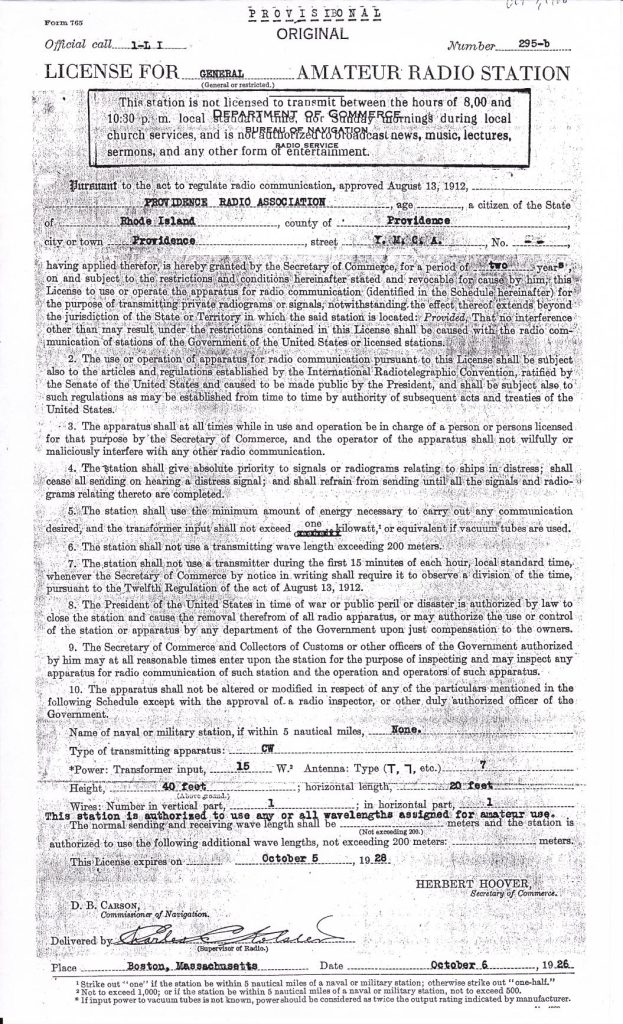
W1LI
In accordance with the international radio regulations prefixes identifying countries of license were added to radio call signs in 1928. So 1LI became W1LI and continued to be licensed through 1930.
| Date | Location | Bands | Power | Notes |
|---|---|---|---|---|
| 1928-1930 | 76 Dorrance Street: Providence (Case-Mead Building)67 | 40&80 | Club Net weekly On 80M |
An undated copy of an annual report to the ARRL shows the PRA located at Rm. 301, 76 Dorrance Street with a club station operating on 3500 at approximately 20 watts plate input power with 10 regular operators. The club showed 53 members with 40 licensed and 25 regularly attending meetings at that time.
W1INM
A license is in the clubs possession was issued on November 21, 1935 with Russell Barnett as trustee at 3 Valley Street68. There is a QSL shown below indicating this call sign in use by the club on 6/17/35. In one undated report to the ARRL the report showed the club active on 3795 and two and a half meters.
| Date | Location | Bands | Power | Notes |
|---|---|---|---|---|
| 1935 | 3 Valley Street, Providence | 3850 KCS | 200 watts input | See QSL card below |
| 1935 | 3 Valley Street, Providence | 80cw & 5M | From ARRL Annual Report, 160 phone rig under construction. | |
| 1937 | 3 Valley Street, Providence | 80 & 5 M | From ARRL Annual Report | |
| 1938 | 3 Valley Street, Providence | 3750 | From ARRL Annual Report | |
| 1939 | 3 Valley Street, Providence | 3850 KCS | From ARRL Annual Report | |
| 1940 – 1941 | 100 Broad Street, Providence** | |||
| 1946 – 1951 | 11 Conduit Street, Providence*** | |||
| 1951- 1954 | 1051 N. Main Street, Providence**** |
* 3 Valley Street was a commercial building. Apparently, the PRA rented this site. Among the other tenants over the years were a dentist office, a beauty parlor, a photographer and a dressmaker’s shop. 69 ** Providence YMCA *** A building that for many years was shown as vacant in city directories. Eventually it was shown as used by the YMCA. **** 1051 North Main Street was the Armory of the Mounted Commands, which for many years was the headquarters of the RI Army National Guard.
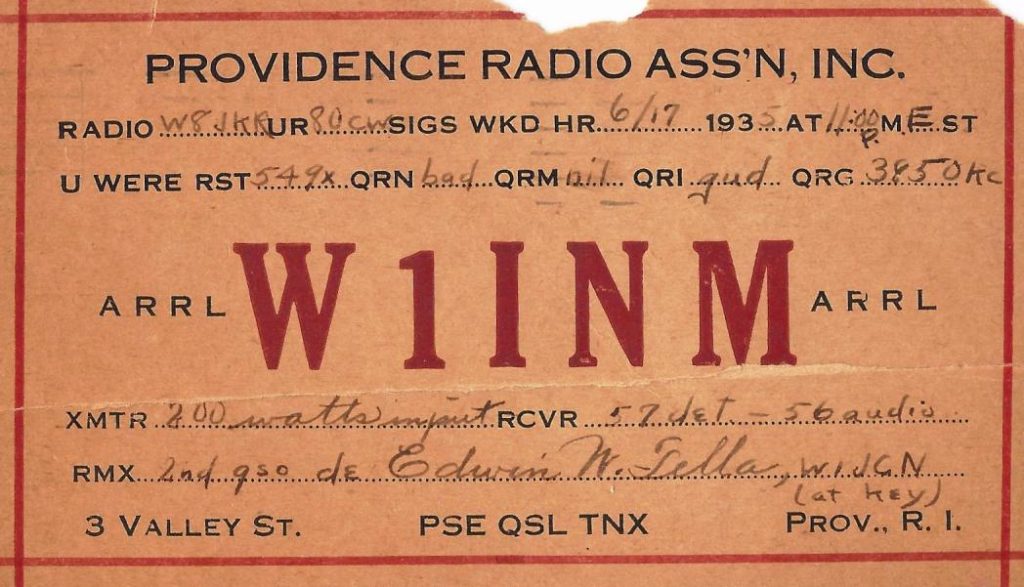
W1OP
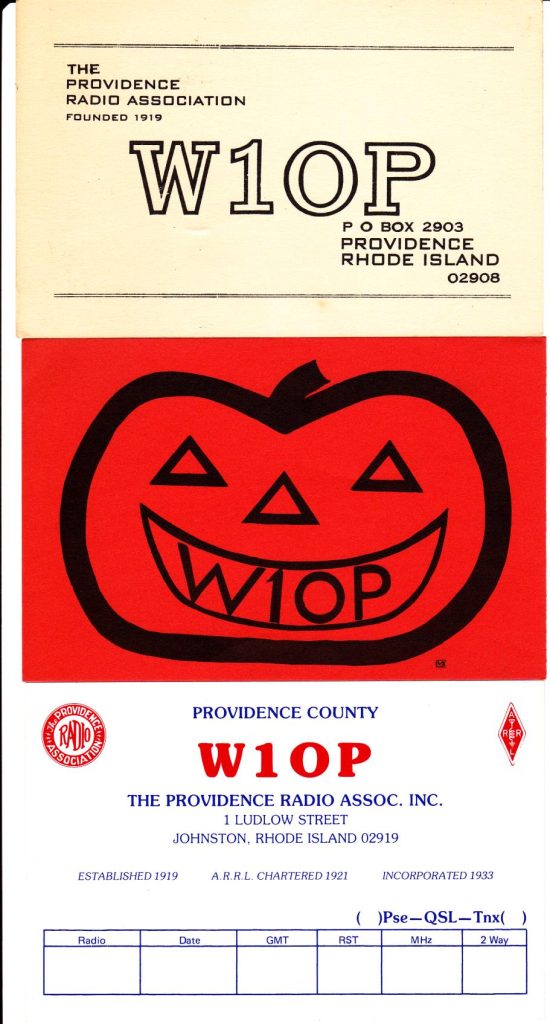
The first occurrence of W1OP as a PRA club station was in 1954 when the club showed a license for 6 months at Darby Road in North Scituate 70 which apparently was the headquarters for the R.I. Civil Defense Agency and the site of the Federal Communications Commission’s WWII monitoring station71. This license issued on 10-14-54 (which is still in the possession of the club) shows the license replaced W1INM, the license had a expiration date of 4-14-55 with Robert C. Bellisle (W1KKE) as trustee. The PRA again showed W1OP at the Darby Road, Scituate address from Fall 1956 through the Fall of 1957 72. With the construction of the new clubhouse on Ludlow Street in Johnston the club moved W1OP to Neutaconanet Hill73. Over the years that call sign has been heard on bands from 160 M to 70 cM. In the 70’s the club added a 220 repeater on the hill. Continually looking for new frontiers in ham radio the W1OP/R ATV repeater on 440 appeared in 198474. W1OP today shows up in everything from contests to rag chews.
| Date | Location | Bands | Power | Notes |
|---|---|---|---|---|
| 1954-1955 | Darby Road: No. Scituate | At RI State Civil Defense Headquarters. | ||
| 1956-1957 | Darby Road: Scitaute | At RI State Civil Defense Headquarters | ||
| 1957-today | 1 Ludlow Street: Johnston (prior to street address just showed Neutaconanet Hill as location) | 160 M to 70 cM | 1.5 kw | In 1957 the club station had a 300 watt transmitter.75 |
WO1ITU
In 1974 and 1975 the club obtained the special call sign WO1ITU76 for use in the World Telecommunications Day Contest and for a limited time in general QSO’s. The charge for this activity was led by George, WA1POJ (later N1RI).
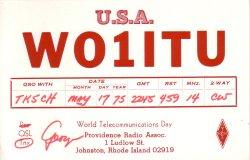
From: lesnouvellesdx.fr – February 15, 2016
WR1ACG
During the 1970’s the Federal Communications Commission (FCC) decided for a time to separately license repeaters. As the PRA was in the process of assembling its 220 machine the club went through the voluminous paperwork (much more involved than some commercial applications) to get a repeater license at 1 Ludlow Street in Johnston. This license was issued on 12-21-73 with John Good, K1HZN as trustee.77
W1AW/1
In 2014 during the ARRL’s 100th anniversary the PRA participated as a station in the WAS challenge using the call sign W1AW/1. The following operators participated from the club in July and November K1PLX, KZ1K, K1DT, W1GS and N1DM. They ended up with over 4400 QSO’s as W1AW/1. Despite the fact this was not using our own club call we were honored to use a call we all know to honor 100 years of the league from the club station.
Notes & references from the original document
- “Amateur Radio Stations of the United States”: Edition June 30, 1925: Department of Commerce, Bureau of Navigation, Radio Service and FCC website
- DeSoto, Clinton B.: Two Hundred Meters and Down: West Hartford, CT: ARRL: 1935: page 114 & 132 (quote from Department of Commerce annual report for 1926)
- Providence Housing Directory 1923-24 and Providence Housing Directory 1927-28
- The Providence House Directory and Family Address Book 1927-1928 (#23):Providence, RI: Sampson & Murdock Co:1927
- License in possession of PRA
- Providence City Directory: R.L. Polk Co.: Boston, MA: 1937 and 1939 editions
- Radio Amateurs Callbook Magazine: Chicago: Spring 1955 (Vol. 33 No. 1) and Summer 1955 (Vol. 33 No. 2) editions
- From notes of a talk given by Frank Donovan, W3LPL to the Potomac Valley Radio Club on November
- Radio Amateurs Callbook Magazine: Chicago:Fall 1956 (Vol. 34 No. 3) thru Fall 1957 (Vol. 35 No. 3)
- Radio Amateurs Callbook Magazine: Chicago:Winter 1957/1958 (Vol. 35 No. 4)
- QST: May 1984:page 128
- Providence Journal: September 15, 1957: pg. 30
- QST: August 1974:pg. 118
- Original license on file at W1OP.
Field Days
It’s hard to find a PRA member past or present who doesn’t remember Field Day or the many stories associated with Field Day. Camaraderie has always been a mark of the PRA both inside and outside the club and nothing brings camaraderie out more than Field Day. People and equipment show up from everywhere. Many members who are not otherwise active make it a point to show up for Field Day. Old friendships are renewed, while newer members get introduced to the other members. As in past years Field Day was an event with people coming out of the woodwork. W3LPL (ex-K1LPL) was a participant from 1959 to 1968 while K6LL/7 (ex-K1JYN) one of the prominent US contesters was a regular operator at 1970’s Field Days.
The 1930’s participation was with low power (less than 20 watts) and in many cases homebrew equipment. The PRA continued over the years to improve its Field Day results from the 23 QSO’s and 522 points in 1939 to 404 QSO’s in 1959 by 15 operators using 2 transmitters (running less than 30 watts) totaling a score of 3861 points. By 1989 operating 2A with a novice station the club’s 15 operators amassed 2167 QSO’s for 6076 points for 28th place out of 532 entries in the 2A class. Every year brings new Field Day activity, in 1970 the club participated with 10 members from the Boy Scout Reservation in Cranston78. Rigs are always front and center at Field days with quite an assortment of stuff. In 1959 there was a KWM1 and National NC300 and a Johnson Viking II, while the early 60’s bought a W1QLD homebrew 807 transmitter and a National NC-303 receiver and a Hallicrafters HT-32 transmitter. In the 1970’s everything from Heathkits to Collins S-Lines (the top of the line radio of the period) could be found in the PRA Field Day tents. Through the ingenuity of some members who were students at Rensellear Polytechnic Institute we also had our own dial up phone system between operating tents.
Field Day stories abound, from the strange antennas, to the strange goings on. Over the years 80 meter 2 half waves in phase to full sized 2 element 40 M quads have shown up at Field Day. Who can forget W1YNE’s late night arrival and driving into a ditch which required a stop in activities for the whole crew to push Gordon’s car out of the ditch. Another memory is K1JYN’s (now K6LL) headphone mounted speakers laying on top of the rig while he operated at 2 AM, keeping the neighboring Boy Scout troop up all night with the sweet sounds of CW (at least to us). Strange ideas seem to be associated with Field Day such as K1HZN’s 1024 foot vee beam to the WA1PJD’s (et al) 60 foot wooden tower that did not make it to Field Day as it collapsed when we tried to raise it at K1JNJ’s QTH.
K1DT has provided the following list of the FD sites since 1971:
- 1971 – Champlin Boy Scout Reservation, Cranston
- 1972 – Highland Rod & Gun Club, Foster
- 1973 – K1JNJ’s QTH, Harmony
- 1974 – Champlin Boy Scout Reservation, Cranston
- 1975-1981 – Naval Transmitting Station, Beavertail Point, Jamestown
- 1982 – Victory Sportsman Club, West Glocester
- 1983-present – Ft. Burnside, Beavertail Point, Jamestown
Over the past 30 years most of the PRA’s Field Day participation has revolved around Beavertail Point in Jamestown. The story of the PRA use of the Jamestown site is recalled by K1DT.
“In 1975, after holding some very FB field days at the Champlin Reservation in Cranston, the Highland Rod and Gun Club in Foster and K1JNJ’s QTH in Harmony, the PRA membership became extreme with the idea of getting permission to use the site of sites, the abandoned US Navy transmitting station at Beavertail Point, in Jamestown.
Every ham of the day had driven down to the southern tip of Jamestown peninsula to look in awe over the hundreds of acres of massive HF antennas. A row of 3 giant rotatable Collins 6-40MHz Log Periodic Dipole Arrays, half dozen huge 2-30 MHz inverted discones each supported by a circle of ten 100 foot telephone poles, dozens of “smaller” 6-30MHz conical monopoles, an impressive 2-30MHz fixed wire log periodic supported by a pair of 130 foot towers was located on the west side of the peninsula, and on the east side was the Massive 600ft “NORD” vertical. US Navy personnel at the guard shack made sure no one was to enter. In the middle of the peninsula stood Ft. Burnside and it’s two radar towers where the Navy Reserve would regularly exercise.
I remember going by as a young boy on a Sunday drive with my parents and being amazed at it all. My parents didn’t understand it all and couldn’t figure out why the AM car radio was filled with strange noises. We had driven down to take a look at a small airplane which managed to crash and get tangled up in one of the inverted discones, and for my dad and I to go fishing off the rocks. What I really wanted to catch was a peek inside that radio station!
Well, as happens with technology and government, things become obsolete, and this is what happened to the US Navy Beavertail Point Transmitting Station in the 70s. The station went dark and all personnel were vacated except for the MPs who guarded it.
In typical Rhode Island fashion, one of the PRA members had a friend who knew the Commander at the Naval Education and Training Command in Newport that had control over the decommissioned station. On a long shot, a proposal was drafted asking for our permission to operate Field Day on the grounds of the transmitting facility. To the amazement and joy of the membership, the permission was granted. We were strictly forbidden from the Ft. Burnside facility.
We were reeling with joy. This was the Mecca of all radio locations in the area. We were to be surrounded by salt water for 270 degrees, and the entire facility was covered in ground screen. Our dipoles and tri-band beams would play like never before. It was to be a field day like no other. Much planning and many reconnaissance missions were made to the site to determine what antennas we would erect and where. It was unlikely we could use any existing antennas, but we were prepared either way just in case. Brown, WA1NZR, a Jamestown local, had been contracted by the Navy to maintain the aviation beacons on the two 130 foot towers that had supported the now gone horizontal wire LP. He assured us it would be no problem to erect a wire between them for just one day, and being a mile from the main facility, it would be invisible. This would be the location of the CW station. We would locate the phone station by the main transmitting facility and use traditional dipoles and a tri-bander, and maybe hook into something big.
Finally the day came. We were greeted at the gate by the guard who checked all the papers, took all our names, license plate numbers, gave us all the rules and watched over most of our activities. We asked permission if we could use some of the towers as supports for our wires. The best we could get was a reluctant approval to attach to an old TV antenna mast on the chimney of the generator building. We were on our best behavior as we were indeed operating on active US military property and the MP had a gun, so we played by the rules. The station was not operational but still 97% intact, the exceptions being the horizontal LP and the 600ft NORD antenna being deemed aviation hazards and taken down.
A mile away at the southern end of the property, down the many overgrown and meandering service roads is where John, K1HZN, established the CW camp, in the shadow of the 130 foot towers left from the horizontal wire LP. Navy reservists were on maneuvers at the adjacent Ft. Burnside property but we kept away from each other. K1HZN fashioned a full size 40 meter lazy H, inspired by Chuck Ashworth, W1BIS. Dave, WA1QOG, and Brown, WA1NZR, climbed the two towers and hung the Lazy H. It was a magnificent sight. The antenna performed wonderfully; with the one unanticipated issue that it collected many KV of wind static. The static charge was so great that the plates of the antenna tuning air variable cap would arc over, and the Teflon insulation of the 4:1 balun was puncturing. We eventually fashioned a static drain choke, but not after receiving several nasty bites of the monster. No one ever had this kind of issue with their backyard 40-meter dipole!
We also had the help of Steve, K1KEC, who supplied us power from his 3 cylinder Kohler generator, brought along his Drake TR6 station and Johnson Thunderbolt amplifier and Roger, K1??? (Now W1OJ). Operating from K1HZNs tent trailer, we amazed onlookers with the performance of the station, half powered by generator and the half by Genesee Cream Ale. Brown provided shuttle transportation between the stations via his Navy issue M-38 (or M-151?) Jeep. All in all, it was an amazing field day.
Indeed, our dipoles and tri-bander worked like never before, but compared to what we were surrounded by, our antennas looked comical. At the end of the Field Day, we all commented that what we really wanted was someday to actually use the existing massive antennas, and we fantasized about what kind of commanding signals we would put on the bands with them.
The next year, 1976, we again were granted permission. There was even more excitement, and of course, everyone wanted to get in on the excitement. We had no problem rounding up operators and volunteers for this Field Day! Joe, WA1TAQ, was so excited to operate that he took his new bride of less than an hour and spent their first honeymoon evening in a tent at the base of a log periodic operating 20 meters phone!
When we arrived however, we found things quite different. The guard was still there, but he wasn’t as concerned with our being there. The appearance of the place had deteriorated, there being little or no maintenance to the grounds or antennas. Some of the antennas showed obvious signs of damage form the elements, especially the 3 rotatable Log Periodics.
We were allowed, or should I say we weren’t prohibited, to use the antennas, and that we most certainly did. A tribander for the first phone station was set up on top of the operations building and performed great. The first experiment was by Bob, W1IMM, and Glenn, K1GDS, who took a length of RG58 from a rig and clip leaded it to the 5-inch coaxial flange of one of the log periodics. Results were amazing, with the antenna pointed in the wrong direction! Being electrical engineers, the rotator control box was opened and the relay logic analyzed. With the aid of another clip lead and a screwdriver jammed into a relay, the drive motor was energized and the antenna began to rotate. And not just the antenna, but also the 80 foot 12 inch diameter supporting mast rotated along with it. It was a sight to be seen. The second phone station operated here on 40 meters where a string of VKs was worked reporting that we were an amazing 599+ down under. The same Lazy H was used down at the CW station.
With 1976 being the US Bicentennial, there was much activity to be seen from Beavertail, including a procession of tall ships. WA1QOG was atop one 130 ft tower as the Good Year blimp flew by with passengers waving to him.
1977 found things different again. There was more deterioration at the site. There was no permanent guard, he met us at the gate and then he left. The site had been overrun and illegal scavengers for scrap had pulled many of the extensive underground copper feedlines up. The main building was empty and litter had taken the place of the transmitters in their bays. Most of the antennas were still up. This year we were going all out. Zaven, W1IUX, constructed a full size 80 meter Bobtail Curtain, and strung it between two of the 100ft poles of the inverted discones. Harry, K1JNJ, connected his National NCX-1000 directly to one of the massive inverted discones. Two of the rotatable LPs were used.
We were working stations like never before, and then came the thunderstorm of all thunderstorms. There we were, all connected to the end of massive antennas. Feedlines were disconnected and we all huddled, as the heavens broke open above us. The lightning was incredible and lasted for hours. There were several direct strikes to the facility. The ground shook, it was like a war zone. We drove around in the pouring rain checking on everyone. Then we came upon Harry, K1JNJ, still in his van at the base of the discone, looking at the charred remains of his prize National NCX-1000. He was having such a run on 80m phone and so much fun that he continued operating through the storm until his antenna took a direct hit. Harry, now SK, spent the next 20 some years trying to repair that rig.
1977 also brought upon some other changes. The Navy had pulled out and the entire facility was handed over to the State of RI with plans for it to become a state park, with the exception of the Ft. Burnside property, which was to be retained for possible further use. That year saw the demise of much of the facility.
We continued to operate there with the permission of the State of RI, Dept of Environmental Management, Parks and Recreation, until 1981, when all the antennas and towers were demolished. We were saddened to visit and see the three rotatable log periodics fallen in the grass, overgrown with brush and being scavenged for aluminum tent poles and fishing outriggers. An effort was begun to salvage one of them, but this is yet another story.
In 1982, our permission was not granted, due to the construction of the Beavertail State Park, so we operated out of a muddy field at the Victory Sportsman Club in W.Glocester. There was hardly any enthusiasm after the past 6 years at Beavertail. We were determined to get back down there.
Due to his prior dealings with the Navy, Brown, WA1NZR, had arranged with them and the State to become the caretaker of the Ft. Burnside property. Just like the transmitting station, “The Bunker” as we called it, had also been subject to vandalism and deterioration from the elements, and the authorities we happy to have someone like Brown watching over and tidying up the place. Brown was living there in rather harsh conditions and loving it. He had a 100ft and a 60 ft radar tower to play with, as well as several 80ft telephone poles.
In 1983 we petitioned the State for permission to use the Ft. Burnside property and have been holding Field Day there ever since.”
Notes & references from the original document
- QST: September 1970:pg. 128
Other Activities
Over the years the club has run many nets for its members, from 80 CW in the 1920’s, 2M AM and 80 SSB in the 70’s. Even though this activity has been sporadic it was another way for the club members to be active in the club and its many activities. It has not been unusual to have members from 3 states checking-in when the club had a regular weekend 80 M SSB net in the 70’s.
During the 70’s the PRA held an auction which lives in the memory of all the members who participated. This vignette from K1DT describing the most memorable part of the auction.
“Around 1973(?) the PRA held a radio auction at the clubhouse. It was talked up by W1EYH on the new 146.10/146.70 FM repeater and therefore attendance was quite good, included many of the notable hams of the day, such as W1EOF, W1QLD (W1MB), W1HQV, K1ABR and W1OTE. A new novice member, WN1QOG (K1DT), had brought up a few items including a recently repaired maroon art deco Setchel Carlson TV. There was some interest in it as it came up on the auction block. “Fat Jack”, W1OTE, (ed- Jack had no issue with this moniker and we use it here with all respect to our departed friend) placed the first bid on it then asked if it worked, to which ‘QOG replied yes, and proceeded to plug it in and turn it on. After warming up a good steady picture appeared, but only seconds later it started to roll, then the horizontal oscillator took off like a rocket emitting a loud squeal which soon turned to a loud pop, followed by a puff of smoke and the familiar smell of burnt electronics. The crowd was still roaring with laughter when Jack said, “tell you what, I’ll pay $50 if someone climbs the PRA tower and drops it off.” Minutes later the entire crowd shuffled out to the parking lot to witness ‘QOG climb the tower with the TV in one hand and drop it from about 35ft to a rousing round of applause. Jack handed over the money to the treasurer.”
Another activity that brought a lot of members to the club was an Old Timer’s Night in the 70’s. A lot of old friends appeared and enjoyed a presentation and demonstration of a vintage spark transmitter by Bob Merriam W1NTE (without an antenna connected). A few members were surprised to hear their calls in the singing note of the rotary spark.
Although not an activity in itself the club has had various newsletters over the years to promote activity among the membership. The club has a few copies of each in the archives. The names have varied according to the time the newsletter was produced. Known names for the various PRA newsletters are: “the Audion”, “PRA Log” (1941), “Neutaconkanut News”, “PRA News” and “The OPerator”. Over the years these promoted activity, kept the members aware of the important issues of amateur radio for the day and also provided just plain gossip and entertainment.
As noted previously the clubs participation in both the ARRL 160 Test and the CQ 160 CW test is an event not to be missed. Strange and long antennas combine with lack of sleep to end up with strange goings on. We cannot soon forget the Johnston Police surrounding the building at one of the 70’s ARRL 160 tests thinking that the cars in the parking lot with out of state plates (K1HZN and K1NTS) were involved in a break-in. WA1RFT (now N1DM) still has memories of looking into the business end of a shotgun with a Johnston cop behind it when answering the knock to the door in the early hours of the morning. More than once we have had to venture out into the woods to repair an antenna in the middle of the night, dragging what seemed like miles of extension cord behind us for the soldering gun. Many members remember coming out of the building on a Sunday morning to dig out your cars from an overnight snowstorm to go home.
Weather was not the only consideration when operating from the hill. The isolation of being one of two buildings on Ludlow Street lead to some strangeness, such as in the case of one contest on a Saturday when the assembled members smelled smoke and went outside to see a large group of fire engines fighting a brush fire 50 feet away from the building. The firefighters seemed quite surprised that any of the ‘WPJB” buildings had people in it.
Contests in general have drawn participation since 1939, under its various calls we accumulated over 148,000 contest QSO’s between 1939 and 2016. It is amazing to consider that these QSO’s were accumulated by a local club that did not exceed 101 members and averaged only about 25 active members in any year.
Over the years it was hard to work at any major electronics company in the Providence area or nearby Massachusetts without running into a PRA member. More than a few members can recall having another member as a work colleague. Lew Bellem W1BES, one of the clubs founders, ran Coto Coil for many years and employed a few hams. Bill Edward’s ran one of Providence’s major electronics distributors W. H. Edwards Co. for many years and Joe Giorgianni, W1PTF, ran the local Galvin (Motorola) two-way franchise for many years. Just some examples of members associated at firms are W1LDL, K1DT and N1DM simultaneously working at the William Dandreta Company at one point in the 70’s (K1HZN had also worked there over the years). Also, it is not unusual even now to see a couple of PRA members like W1GS and N1DM meet at a Raytheon Company facility.
Many of the members moved on to higher education and could be found at many local institutions like the University of Rhode Island, Brown University and Providence College, and usually in that schools ham club.
Today e-mail is a meeting point that the clubs founders could not have even conceived of and allows both new and old members to keep in touch with the goings on at the PRA.
Appendix 1 – List of Abbreviations Used
This is a history relating to amateur radio, and that hobby has its own lexicon, a lot of terms and abbreviations from its lexicon have crept into this history. Below is a list of some abbreviations used in this manuscript along with some explanation of the basis of the terms and abbreviations.
- ARRL
- American Radio Relay League, the national organization of amateur radio operators and their local clubs. The ARRL has been located in the vicinity of Hartford, CT since its inception and is currently located in Newington, CT. They operate a station under the call sign W1AW.
- Band
- A group of frequencies between two defined limits. With the exception of 60 M, (which is channelized like the TV bands), hams are allowed to operate any frequency in a range they are licensed for. Ham bands are historical referred to as the xx meter band. This refers to the wavelength of the radio waves in the center of the band. (i.e.: the 160 M band extends from 1800 to 2000 KHz).
- Call sign
- A unique call sign is assigned to each non-governmental radio station in the US by the Federal Communications Commission (or its predecessor organizations). Amateur radio operators and clubs have call signs assigned to them. These may be reissued over time as users fail to renew their call signs or die. But, at a single point in time the call sign represents a particular radio station or ham operator.
- Contest
- Various amateur radio organizations sponsor contests where amateurs attempt to contact as many amateurs as possible of a particular period of time. In many cases these are limited in communication mode, frequency band or other restrictions established by the sponsor.
- CW
- Continuous wave telegraph, referring typically to a contact with another station using Morse code.
- Division
- The organizational subdivision of the American Radio Relay League consisting of all the ARRL sections in a particular region of the country (in the case of the PRA this would be the New England Division).
- FAX
- An abbreviation for facsimile systems current to those used in home and businesses now, in the ham context these apply to a facsimile transmission via radio.
- FCC
- Federal Communications Commission, the federal agency responsible for the regulation and licensing of non-governmental radio stations and equipment in the US.
- Ham
- bands are historical referred to as the xx meter band. This refers to the wavelength of the radio waves in the center of the band. (i.e.: the 160 M band extends from 1800 to 2000 KHz). Call sign A unique call sign is assigned to each non-governmental radio station in the US by the Federal Communications Commission (or its predecessor organizations). Amateur radio operators and clubs have call signs assigned to them. These may be reissued over time as users fail to renew their call signs or die. But, at a single point in time the call sign represents a particular radio station or ham operator. Contest Various amateur radio organizations sponsor contests where amateurs attempt to contact as many amateurs as possible of a particular period of time. In many cases these are limited in communication mode, frequency band or other restrictions established by the sponsor. CW Continuous wave telegraph, referring typically to a contact with another station using Morse code. Division The organizational subdivision of the American Radio Relay League consisting of all the ARRL sections in a particular region of the country (in the case of the PRA this would be the New England Division). FAX An abbreviation for facsimile systems current to those used in home and businesses now, in the ham context these apply to a facsimile transmission via radio. FCC Federal Communications Commission, the federal agency responsible for the regulation and licensing of non-governmental radio stations and equipment in the US. Ham An alternate (slang) term for an amateur radio operator.
- Hamfest
- A convention of ham radio operators usually including technical talks, vendor displays and social meetings.
- Phone
- Refers to a contact via a voice mode as opposed to a Morse code contact.
- QSL
- Refers to a post card that verifies a contact with another ham station.
- QSO
- A telegraph operator’s abbreviation for a contact made between two radio stations, this term is used in amateur radio not only for contacts by telegraph but also by those contacts by voice or other radio modes
- QST
- The monthly magazine of the American Radio Relay League
- Section
- The organizational subdivision of the American Radio Relay League covering a state or portion of state (in the case of the PRA this would be the Rhode Island section).
- sk
- A shorthand for “silent key” , which refers to a ham radio operator who has died, hence his Morse code key is silent. (At one time hams only communicated by Morse code so every ham had a Morse code key).
- RTTY
- radio teletype
- XYL
- Telegrapher’s abbreviation for ex-young lady, referring to a married woman.
- YL
- Telegrapher’s abbreviation for young lady. The lady being not married.
Appendix 2 – Other References
The supplied 2016 PDF contains this appendix heading but no reference entries on the page.
Appendix 3 – PRA Membership Roster as of 2016
This roster is an attempt to show all PRA members since the beginning and is built on other previous lists that have been maintained and published by the PRA, especially the lists shown in the 1956 and 1958 N.E. Division Convention Booklets (the PRA was the sponsor of these conventions). Unfortunately, fragmentary records make it difficult to guarantee that we have included every member over the past 80 years. Also, as many people have had multiple calls (especially in the 20’s, 30’s and since the 70’s) we have only shown calls we are aware of by either club records or other published accounts. As in the past the list is presented sorted by surname. Anyone who notes an error or omission is asked to please contact the PRA and provide corrections.
The supplied PDF contains the introductory roster note above, but no individual roster entries follow in this file.
Appendix 4 – PRA Officers Database
A significant amount of this data is from the annual reports of the PRA to the American Radio Relay League (ARRL). Those reports are in the club files at the ARRL.
| YEAR | PRESIDENT | PRES. CALL | VICE PRESIDENT | VP CALL | SECRETARY | SEC’Y CALL | TREASURER | TRES. CALL |
|---|---|---|---|---|---|---|---|---|
| 1921 | LEWIS A. BELLUM | 1BES (1WY) | LEWIS C. LEIGHTON | (1ETD) | ||||
| 1922 | L.C. LEIGHTON | (1ETD) | ||||||
| 1922 | HORACE YOUNG | (1CAB) | ALPHA A. LEARNED | (1ZQ,1ZZ,1AAU,1AGC) | EUGENE MCCULLOUGH | (1CAY) | ||
| 1923 | ALPHA A. LEARNED | 1AAU (1ZZ, 1ZQ,1AGC) | H. YOUNG | 1CAB | N. MILLER | (1AWE) | ||
| 1924 | CRESTON F. LAAGER | 1BGI | A. A. LEARNED | 1ZQ, 1ZZ, 1AAU, 1AGC | D.A. O’CONNOR | 1AWV | ||
| 1925 | ||||||||
| 1926 | ||||||||
| 1927 | ||||||||
| 1928 | ARTHUR B. ASHWORTH | HOWARD C. MANEY | (1AKK) | NORMAN H. BLAKE | ||||
| 1928 | ||||||||
| 1929 | ||||||||
| 1930 | ROBERT THOMPSON | (W1CKB) | ||||||
| 1932 | HORRACE A. YOUNG | W1CAB | HOWARD C. MANEY | (1AKK) | THOMAS L. O’CONNELL | (1PB) | CHESTER W. WARD | (1ARK, W1ARK) |
| 1934 | STANLEY ATKINSON | W1AFO | ||||||
| 1935 | RUSSELL BENNETT | W1GTN | KENNETH FLETCHER | W1IQF | T.E. FLETCHER | |||
| 1936 | ||||||||
| 1937 | RUSSELL BENNETT | (1BHU, W1GTN) | CLAYTON GORDON | (W1HRC) | AUSTIN CHADWICK JR. | (W1GTS) | ||
| 1938 | RUSSELL BENNETT | (1BHU, W1GTN) | CLAYTON GORDON | (W1HRC) | GEORGE P. EARNSHAW | (W1LYE) | ||
| 1939 | CHESTER LYON | W1JXA | JOHN BRISTOW | W1JP | A. LANGHAMMER | W1LDL | ||
| 1940 | ANTON E. LANGHAMMER | (W1LDL) | ||||||
| 1941 | EDWARD L. KING | W1LCS | ALPHONSE TOMASZEWSKI | W1HJB | GEORGE P. EARNSHAW | W1LYE | ||
| 1945 | NICHOLAS ABBENANTE | (W1BTV) | THEODORE DAVIS | W1NLF | W1NLF | ROBERT C. BELLISLE | W1KKE | |
| 1946 | ROBERT C. BELLISLE | W1KKE | JOHN H. TITTERINGTON | W1EOF | ASHLEY ATHERTON | CHARLES P. KENYON | W1AEI | |
| 1947 | GEORGE P. EARNSHAW | W1LYE | CARL GETTER | W1MIJ | W1AIE | |||
| 1948 | BURTON E. MULLEN | W1IQZ | RICHARD A. CORDIN | W1NZR | MERRILL P. BUDLONG | W1QLD | ROBERT C. BELLISLE | W1KKE |
| 1949 | HARRIE L. DAVENPORT | W1PCQ | MERRILL P. BUDLONG | W1QLD | ROBERT C. BELLISLE | W1KKE | ||
| 1950 | RICHARD A. CORDIN | W1NZR | M.P. BUDLONG | W1QLD | ALBERT E. MARTIN JR. | W1RAY | ROBERT C. BELLISLE | W1KKE |
| 1951 | RICHARD A. CORDIN | W1NZR | M.P. BUDLONG | W1QLD | (THOMAS A. BURNS, JR.) | W1CN | ROBERT C. BELLISLE | W1KKE |
| 1951 | ||||||||
| 1952 | DR. E. Z. WATTMAN | W1SIK | ||||||
| 1952 | EDWIN Z. WATTMAN | W1SIK | ALBERT N. FARSER | W1KCS | CHARLES P. KENYON | W1AEI | WALTER BUTTERFIELD | WN1VAY |
| 1953 | MALCOLM C. BROMBERG | W1SGA | EUGENE B. PETIT | W1BIL | JUNE A. BURKETT & CHARLES KENYON | W1VXC & W1AEI | ROBERT C. BELLISLE | W1KKE |
| 1954 | MALCOLM C. BROMBERG | W1SGA | WALTER B. HANSON, JR. | W1KKR | CHARLES KENYON & R.H. ROTHMAN | W1AEI & W1TQW | ROBERT C. BELLISLE | W1KKE |
| 1955 | MALCOLM C. BROMBERG | W1SGA | WALTER B. HANSON, JR. | W1KKR | FRED STONELY | W1VZP | ROBERT C. BELLISLE | W1KKE |
| 1956 | WALTER HANSON | (W1KKR) | ROBERT ROTHMAN | (W1TQW) | FRED L. SLONELY | (W1VZP) | ||
| 1956 | WALLY HANSON | (W1KKR) | BOB ROTHMAN | (W1TQW) | HOWARD SCHOLZ | WN1HIK | ROBERT C. BELLISLE | W1KKE |
| 1957 | WALLY HANSON | (W1KKR) | BOB ROTHMAN | (W1TQW) | FREDERICK L. STONLEY | W1VXP | ROBERT C. BELLISLE | W1KKE |
| 1958 | ROBERT H. ROTHMAN | W1TQW | FREDERICK L. STONELY | W1VXP | ZAVEN TENKARIAN(CORRES.), ALBERT C. VanHERPE, WILLIAM H. SCHOLZ (ASST),W1FIG | W1IUX W1CPC W1HIJ W1FIG | HOWARD H. SCHOLZ | W1HIK |
| 1959 | FREDERICK L. STONLEY | W1VZP | H. STANLEY PARKER | W1CJT | WILLIAM SCHOLZ, ZAVIN TENKARIAN | W1HIJ W1IUX | HOWARD H. SCHOLZ | W1HIK |
| 1960 | FREDERICK L. STONLEY | W1VZP | JOHN F. MURPHY | K1LRP | JOSEPH J. DEAN SR. | K1JAI | HOWARD H. SCHOLZ | W1HIK |
| 1961 | ROBERT C. BELLISLE | W1KKE | W1VAY | HOWARD H. SCHOLZ | W1HIK | EDWARD L. SULLIVAN | K1NVS | |
| 1962 | ROBERT C. BELLISLE | W1KKE | JOHN MURPHY | K1LRP | HOWARD H. SCHOLZ & FRANK DONOVAN (CORRES.) | W1HIK & K1LPL | EDWARD L. SULLIVAN | K1NVS |
| 1963 | ROBERT C. BELLISLE | W1KKE | EUGENE PETIT | W1BIL | ALEX MCROBERTS | K1MZS | FRANK DONOVAN | K1LPL |
| 1964 | EUGENE PETIT | W1BIL | FLORENCE WOLSTEENHOLME | K1DWH | HERMAN ALLEY | W1JDX | FRANK DONOVAN | K1LPL |
| 1965 | EUGENE PETIT | W1BIL | FLORENCE WOLSTEENHOLME | K1DWH | HOWARD H. SCHOLZ | W1HIK | ROBERT C. BELLISLE | W1KKE |
| 1966 | FRANK DePETRILLO | W1EYH | JOSEPH E. GALLAGHER | WA1DOO | THOMAS DePETRILLO | W1IUP | ROBERT C. BELLISLE | W1KKE |
| 1967 | FRANK DePETRILLO | W1EYH | ARMAND DEFUSCO | W1WKO | W. JOHN GOOD | K1HZN | ROBERT C. BELLISLE | W1KKE |
| 1968 | FRANK DePETRILLO | W1EYH | ARMAND DEFUSCO | W1WKO | W. JOHN GOOD | K1HZN | ROBERT C. BELLISLE | W1KKE |
| 1969 | FRANK DePETRILLO | W1EYH | GEORGE BOUSQUET | WA1IQH | W. JOHN GOOD | K1HZN | ROBERT C. BELLISLE | W1KKE |
| 1970 | FRANK DePETRILLO | W1EYH | WILLIAM FRANKLIN | WN1LAD | W. JOHN GOOD | K1HZN | ROBERT C. BELLISLE | W1KKE |
| 1971 | W. JOHN GOOD | K1HZN | WILLIAM FRANKLIN | WA1LAD | DOMENIC MALLLOZZI | ROBERT C. BELLISLE | W1KKE | |
| 1972 | WILLIAM FRANKLIN | WA1LAD | GORDON FOX | W1YNE | DOMENIC MALLLOZZI | ROBERT C. BELLISLE | W1KKE | |
| 1973 | WILLIAM FRANKLIN | WA1LAD | W. JOHN GOOD | K1HZN | DOMENIC MALLLOZZI | WN1RFT | ROBERT C. BELLISLE | W1KKE |
| 1974 | LUCIEN LAMONTAGNE | WA1PJD | STEVEN P/ ARNOLD | WN1RLL | DAVE TESSITORE | WA1QOG | ROBERT C. BELLISLE | W1KKE |
| 1975 | LUCIEN LAMONTAGNE | WA1PJD | GEORGE SIMMONS | WA1POJ | DAVE TESSITORE | WA1QOG | ROBERT C. BELLISLE | W1KKE |
| 1976 | HARRY B. SMITH | K1JNJ | WILLIAM FRANKLIN | WA1LAD | JOHN WINMAN | WA1RKL | ROBERT C. BELLISLE | W1KKE |
| 1977 | HARRY B. SMITH | K1JNJ | WILLIAM FRANKLIN | WA1LAD | JOHN WINMAN | WA1RKL | ROBERT C. BELLISLE | W1KKE |
| 1978 | ED MCGIVENEY | WA1TFF | JOHN WINMAN | WA1RKL | JEFF ALSOP | W1OH | VICTOR FARMER | K1IVX |
| 1979 | K1GDS | DAVE TESSITORE | K1DT | W. JOHN GOOD | W1GS | JOE J. VARIN | WA1TAQ | |
| 1980 | ZAVIN TENKARIAN | N1AKO | DAVE TESSITORE | K1DT | W. JOHN GOOD | W1GS | JOE J. VARIN | WA1TAQ |
| 1981 | ZAVIN TENKARIAN | N1AKO | DAVE TESSITORE | K1DT | W. JOHN GOOD | W1GS | JOE J. VARIN | WA1TAQ |
| 1982 | ZAVIN TENKARIAN | N1AKO | DAVE TESSITORE | K1DT | W. JOHN GOOD | W1GS | JOE J. VARIN | WA1TAQ |
| 1983 | ZAVIN TENKARIAN | N1AKO | DAVE TESSITORE | K1DT | W. JOHN GOOD | W1GS | GILBERT BROWN | N1BBM |
| 1984 | BOB VOTA | WB1FDY | BOB MANCINI | K1HGC | JOHN WINMAN | WA1RKL | GILBERT BROWN | N1BBM |
| 1985 | BOB VOTA | WB1FDY | BOB MANCINI | K1HGC | ||||
| 1985 | BOB VOTA | WB1FDY | BOB MANCINI | K1HGC | JOHN WINMAN | WA1RKL | GILBERT BROWN | N1BBM |
| 1986 | BOB MANCINI | K1HGC | FRANK DePETRILLO | W1EYH | JOHN WINMAN | KZIK | GILBERT BROWN | N1BBM |
| 1987 | BOB MANCINI | K1HGC | FRANK DePETRILLO | W1EYH | JOHN WINMAN | KZ1K | GILBERT BROWN | N1BBM |
| 1988 | BOB MANCINI | K1HGC | JOHN WINMAN | KZ1K | ||||
| 1989 | GILBERT BROWN | N1BBM | W. JOHN GOOD | W1GS | ||||
| 1990 | GILBERT BROWN | N1BBM | W. JOHN GOOD | W1GS | ||||
| 1991 | FRANK DePETRILLO | W1EYH | W. JOHN GOOD | W1GS | ||||
| 1993 | FRANK DePETRILLO | W1EYH | N1JDA | W. JOHN GOOD | W1GS | JOHN WINMAN | KZ1K | |
| 1994 | FRANK DePETRILLO | W1EYH | N1JDA | W. JOHN GOOD | W1GS | JOHN WINMAN | KZ1K | |
| 1995 | GILBERT BROWN | N1BBM | N1JDA | K1DS | JOHN WINMAN | KZ1K | ||
| 1994 | FRANK DePETRILLO | W1EYH | N1JDA | W. JOHN GOOD | W1GS | JOHN WINMAN | KZ1K | |
| 1997 | DAVID SMITH | WA1UWU | GILBERT BROWN | N1BBM | W. JOHN GOOD | W1GS | JOHN WINMAN | KZ1K |
| 1998 | DAVID SMITH | WA1UWU | W. JOHN GOOD | W1GS | ||||
| 1942 ? | CLAYTON C. GORDON | W1HRC | GEORGE P. EARNSHAW | (W1LYE) | ||||
| 1944 ? | ALPHONSE TOMASEWSKI | W1HJB | THEODORE DAVIS | W1NLF | THEODORE DAVIS | (W1NLF) | ||
| ALPHONSE TOMASEWSKI | W1HJB | NICHOLAS ABBENANTE | W1BTV | |||||
| HORRACE YOUNG | W1CAB | DELBERT WICKE | W1IZO | CHESTER S. LYON | (W1JXA) | |||
| JOHN BRISTOW | W1JP | EDWARD KING | W1LCS | ANTON E. LANGHAMMER | (W1LDL) | |||
| RUSSELL SMITH | (1EI) | JOHN RICHARDSON | ROBERT THOMPSON | (W1CKB) | ||||
| NICHOLAS ABBENANTE | ex-W1BTV |
Appendix 5 – PRA Contest List
The following list is an attempt to list club activity for some of the many contests it has participated in as a club. This list is included to show activities that the club members have participated in as a group. These contests not only show the competitive nature of the members but also the drive to improve skills and the technical competence of the station required to put in a score on those contests. Some of the scores clearly show more than a pedestrian effort at participation. Although not a complete list, a look through the list will give you some idea of the activity level of the PRA as a group over the 70 years the club has participated in on the air activities as a group.
The supplied PDF contains the introduction to the contest list, but no contest entries follow in this file.
Appendix 6 – Publications by PRA Members
Many of the PRA members (and ex-members) have published articles on various facets of the hobby over the years. Shown below is the first attempt to gather together in one place a list of magazine articles and other publications by PRA members. For the sake of completeness we have shown editorial material along with technical material. We hope this will give you a glimpse into the activity of the PRA over the years.
Note: This list does not include monthly section manger columns published in QST by Walter B. Hanson Jr.- W1KKR: June R. Burkett – W1VXC: Gordon Fox – W1YNE, Jack Titterington -W1EOF, Bob Vota – WB1FDY and other members when they served as ARRL Section Communications Manager for Rhode Island.
The supplied PDF contains the introduction and note above, but no publication entries follow in this file.
Credits
This project would not have been completed without the help of many people, both hams and non-hams.
The details in many parts of this history are directly attributable to the ARRL via their QST magazine and the excellent records of affiliated clubs maintained by their Club and Training Department. We are indebted especially to the ARRL for providing copies of the club’s correspondence with the ARRL and allowing us to use the league’s call book collection to research the club licenses. We are especially indebted to the help provided by the late John Hennesey N1KB of the ARRL staff for help in locating call sign information and suggesting other avenues of investigation. Reading the footnotes it is obvious that QST magazine has been a major source of this history. The monthly section news and station activities columns have been a goldmine of information, some of it incredibly detailed for the limited space available for the section mangers column every month. The QST columns by the various Section Managers (both members and non-members) have shown the continued activity of the PRA.
The help of the Providence Public Library’s reference and periodicals departments, who have been a major source of information, was indispensable. The many references to newspaper articles are based on the “RI Index” maintained by the Providence Public Library’s Reference Department, this literally shows every article of local interest in the Providence Journal and Evening Bulletin. Also, thanks to the staff of the Boston Public Library for help locating early radio information in the government documents, periodicals and microform departments. The rediscovery of the 1LI and W1LI call signs is based on the incredible collection of government call books on file with the government document departments of the Brown University Library, Boston Public Library and University of Vermont Library in Burlington (into the 1930’s the US Government published ‘official’ call books). We are also indebted to the Worcester Polytechnic Institute, Rhode Island Historical Society Library, Worcester Public Library, Tisch Library at Tufts University and the University of Connecticut Library for use of their periodical collections for research.
Special thanks to W1GS (ex-K1HZN), K1DT (ex-WA1QOG), W1EOF (ex-WA1PWA), W1EYH and W1CPC who have reviewed the many drafts of this history, provided copies of important documents and have made many important observations and corrections that have led to a more complete history. A special thanks to K1DT for his wonderful stories of the Beavertail FD site and the 1970’s auction, that has made this history come alive. I also want to give a special thanks to Larry DePetrillo, N1QGO for his discovery of a copy of a 1LI license shown in the attachments to the text and W3LPL for his discovery of a 1935 W1INM QSL card.
I also must take the time to offer thanks to my wife Karen who in addition to understanding the need to devote many hours to this project, has acted as editor, laboring at turning my fractured sentences into presentable text.